

Picture your brain for a moment.
Not the abstract concept of it. The actual physical organ sitting inside your skull right now, processing these words, holding your memories, regulating your mood, deciding what matters and what does not.
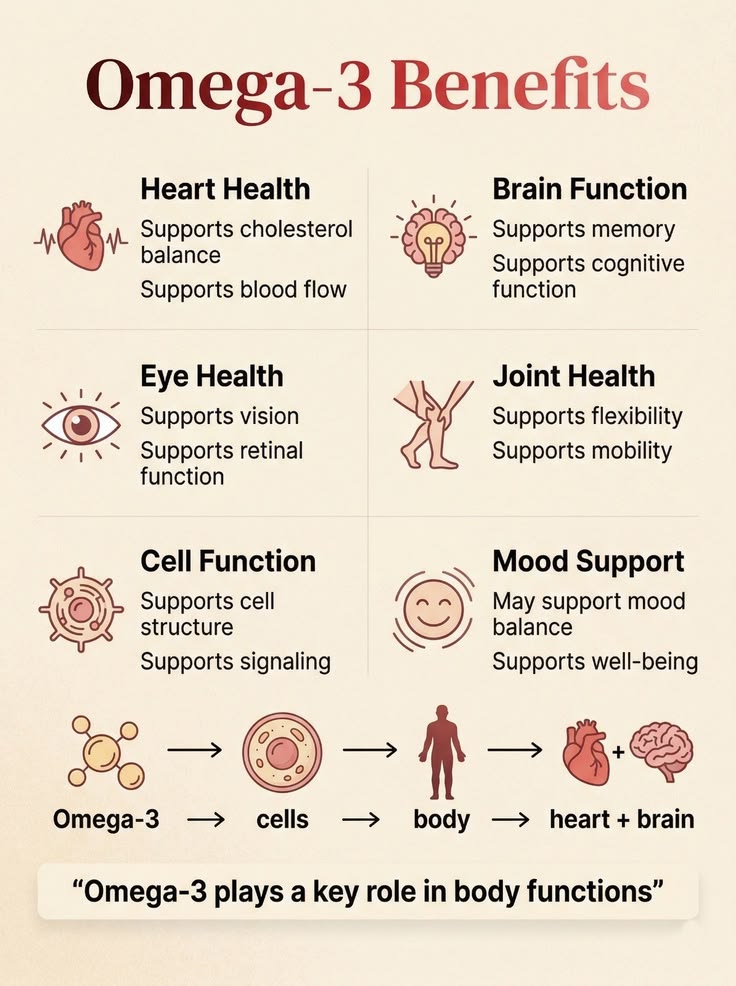
About 60 percent of that organ is fat. And a significant portion of that fat is made up of omega-3 fatty acids, specifically a compound called DHA, docosahexaenoic acid. Your brain does not just use DHA. It is structurally built from it. Every neuron membrane, every synaptic connection, every myelin sheath that allows electrical signals to travel efficiently between cells, all of it depends on an adequate supply of this particular fatty acid.
Now consider that your body cannot make DHA in meaningful quantities on its own. It must come from what you eat. And consider that the modern diet, even among people who would describe themselves as eating reasonably well, is dramatically lower in omega-3 than at any point in human history.
That gap between what your brain is built to run on and what most people are actually providing it is, I think, one of the most underappreciated factors in the epidemic of cognitive decline, depression, anxiety, and neurological dysfunction we are seeing across the developed world.
A Brief History of How We Got Here
For the vast majority of human evolutionary history, our ancestors ate large quantities of fish, shellfish, wild game, and foraged plants. These food sources are all rich in omega-3 fatty acids. The ratio of omega-6 to omega-3 in the ancestral diet is estimated to have been somewhere between 1:1 and 4:1.
The industrialisation of food production in the twentieth century changed this with remarkable speed. Grain-fed livestock replaced pasture-raised animals. Seed oils extracted from corn, soy, and sunflower became the primary cooking fats in most households, replacing butter, lard, and olive oil. Processed convenience foods, manufactured almost entirely with these omega-6-heavy oils, became dietary staples.
The omega-6 to omega-3 ratio in the average Western diet today sits somewhere between 15:1 and 20:1. Some estimates put it higher.
This is not a minor adjustment. It is a fundamental shift in the fatty acid composition of the human diet, occurring over roughly two to three generations, far too fast for our biology to adapt. And the consequences are showing up in the research in ways that are difficult to ignore.
What Happens Inside the Brain When Omega-3 Is Low
Neurons communicate across tiny gaps called synapses. For this communication to work efficiently, the membranes surrounding neurons need to be fluid and flexible, capable of rapid structural changes that support signal transmission.
DHA is what gives neuronal membranes this fluidity. When DHA is abundant, membranes are supple and responsive. When it is deficient, membranes become stiffer, signal transmission slows, and the efficiency of neural communication decreases in ways that show up as slower thinking, lower mood, poorer memory consolidation, and reduced cognitive flexibility.
Beyond membrane structure, DHA plays a role in producing compounds called resolvins and protectins, which are molecules your brain uses to resolve neuroinflammation. A brain low in DHA is less able to manage its own inflammatory processes, and neuroinflammation is increasingly being linked to depression, anxiety, cognitive decline, and the progression of neurodegenerative conditions.
EPA, the other primary long-chain omega-3 fatty acid, has a different but complementary role. Its most documented effect is on mood and inflammation. EPA competes directly with arachidonic acid, an omega-6 fatty acid, for the enzymes that produce inflammatory signalling molecules. When EPA is present in adequate amounts, the production of pro-inflammatory eicosanoids is reduced and the ratio shifts toward compounds that support a calmer, less reactive immune environment.
Multiple meta-analyses of clinical trials have found that EPA supplementation at doses of around 1 gram per day or higher produces meaningful reductions in depression symptoms, comparable in some studies to antidepressant medication in mild to moderate cases. This does not make omega-3 a replacement for medical treatment. But it does suggest that the brain’s fatty acid environment is far more relevant to mental health than it is usually given credit for.
The Conversion Problem Most People Do Not Know About
When people discover that plant foods like flaxseed, chia seeds, and walnuts contain omega-3, they sometimes assume that eating these foods is equivalent to eating fish. It is not, and understanding why matters.
The omega-3 in plant foods is called ALA, alpha-linolenic acid. Your body has to convert ALA into EPA and then into DHA to use it for the functions described above. This conversion process is performed by a series of enzymes, and it is inefficient. Research consistently shows that humans convert somewhere between 5 and 15 percent of dietary ALA into EPA, and less than 1 percent into DHA.
This means that the omega-3 in a tablespoon of flaxseed oil, while not without value, delivers a tiny fraction of the EPA and DHA that the same quantity of sardines or salmon would provide. For people following plant-based diets, this is genuinely important to understand, because DHA deficiency is common in populations that rely on ALA as their primary omega-3 source.
Algae-based DHA supplements are the solution here. Algae is where fish get their DHA in the first place, fish accumulate it by eating algae and smaller marine organisms. Going directly to the algae source bypasses the fish entirely and provides preformed DHA that does not require conversion. These supplements are now widely available and represent the most practical solution for people who do not eat fish.

Getting Practical: What This Actually Looks Like in a Week
I am aware that information without application is just interesting trivia. So here is what an adequate omega-3 intake looks like concretely, based on both the research and my own approach.
Two to three servings of oily fish per week covers most of what the research suggests is needed for general brain and cardiovascular health. Sardines are my first recommendation because they are inexpensive, require no preparation, and are exceptionally high in both EPA and DHA. A single tin of sardines in olive oil contains approximately 1.5 to 2 grams of combined EPA and DHA. Mackerel, salmon, herring, and anchovies are all excellent alternatives.

On days when fish is not on the menu, I supplement with a high-quality fish oil or algae oil providing at least 1 gram of combined EPA and DHA. I look for products that have been third-party tested for oxidation and heavy metals, because rancid fish oil is not only ineffective but potentially counterproductive, and contamination is a genuine consideration with lower quality products.
Walnuts and ground flaxseed are worth including as daily additions, not as replacements for direct EPA and DHA sources, but because they provide ALA and other nutrients that support the broader fatty acid ecosystem. A small handful of walnuts with breakfast and a tablespoon of ground flaxseed stirred into oats costs almost nothing and adds consistent nutritional value over time.
Before significantly increasing omega-3 supplementation, particularly if you take blood-thinning medications or are preparing for surgery, please check with your doctor. For more information, see our medical disclaimer. High dose omega-3 has mild blood-thinning properties that are relevant in certain clinical contexts.
The Signs That Made Me Take This Seriously
I want to share something personal here because I think it makes this more real than statistics alone.
There was a period in my life, about three years ago, when my thinking felt consistently slower than it used to. Not dramatically. Just a kind of lag. Words taking a fraction longer to come. Concentration fraying at the edges of tasks it would not have frayed on before. A flatness to my mood that was not depression exactly, more like a reduction in the natural variation of feeling that makes a day feel alive. Learn more about my approach to wellness.
I had blood work done. Nothing remarkable came back. I started tracking my diet more carefully and realised I was eating fish perhaps once a month. The rest of my fat intake was coming primarily from nuts, dairy, and whatever oils were used in the foods I was buying.
I changed the fish intake first. Two tins of sardines a week, non-negotiable. Added a daily algae oil capsule. Within about six weeks I noticed the lag in my thinking had softened. Within three months the mood flatness had lifted enough to feel like a meaningful shift.
I cannot say with certainty that omega-3 was the only variable. But it was the most significant thing I changed, and the timeline matched closely enough to take seriously.
One More Thing Worth Knowing
Omega-3 fatty acids oxidise quickly. The oil goes rancid when exposed to heat, light, and air, and rancid omega-3 is worse than no omega-3 because oxidised fats generate free radicals that actively damage cell membranes.
Store fish oil capsules in the fridge, away from light. Buy smaller quantities more frequently rather than a large supply that will sit for months. If a fish oil supplement tastes or smells strongly fishy, that is a sign of oxidation. Fresh, high quality fish oil has a mild, clean smell, not a rank one.
The same principle applies to whole fish. Fresh oily fish cooked gently, not deep fried in high-heat seed oils, delivers its omega-3 intact. Deep frying at high temperatures damages the very fatty acids you are trying to consume.
Small details, but they matter when you are trying to get genuine benefit from something rather than just going through the motions of taking it.
Do you eat fish regularly, or is this an area where you know your diet falls short? I ask without judgment because this was one of my own biggest gaps for years. Find out more about how I approach nutrition and wellness.
Leave a Reply