
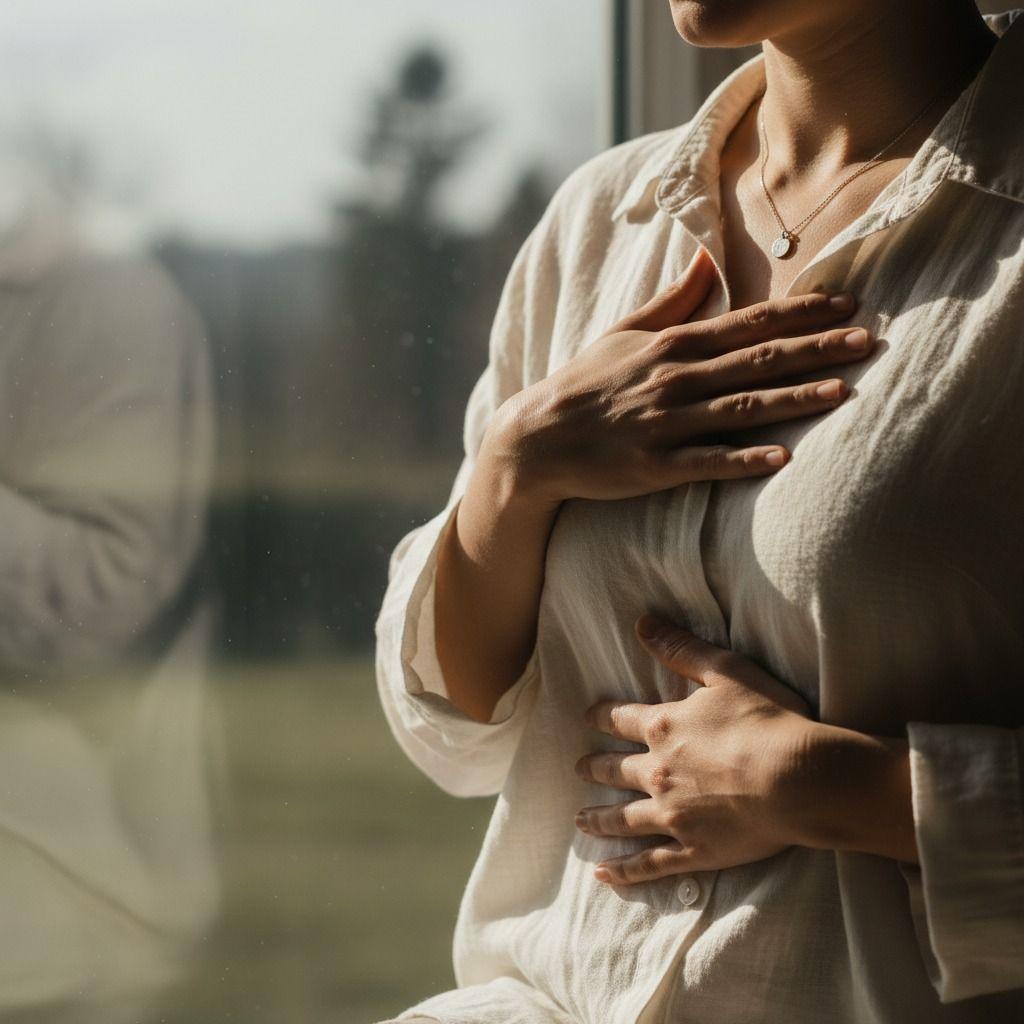
Have you ever resolved a stressful situation mentally, talked it through, understood it, made peace with it, and then noticed that your body had not received the memo? This experience has a name: somatic anxiety.
The chest is still tight. The shoulders are still up near your ears. There is a low hum of tension in your stomach that has no current explanation.
Your sleep is still fragmented even though the thing you were worried about is no longer an active problem. There is no catastrophic thinking, no spiralling, no identifiable worry to grab hold of and examine. There is just a body that is still braced for something that the conscious mind has already filed away.
Somatic anxiety is one of the most common and least understood forms of stress that people carry, often for years, without ever having a name for it. It is not anxiety in the way most people think about it. It lives in the body, not the mind.
The Body Keeps the Score, Literally
The phrase the body keeps the score was made famous by psychiatrist Dr. Bessel van der Kolk, whose research on trauma and the nervous system fundamentally changed how many practitioners understand the relationship between psychological experience and physical state.
The core insight is this: the nervous system does not process stress the way a computer processes a task, completing it and moving on with no trace remaining. It processes stress through the body, through muscle tension, postural changes, alterations in breathing patterns, shifts in digestive function, and changes in heart rate variability.
When a stressor is resolved cognitively but not physically discharged, the body holds the unresolved activation in its tissue and its nervous system patterning. This is not metaphor. It is measurable physiology. Chronic muscle tension, reduced heart rate variability, elevated baseline cortisol, shallow breathing that never fully returns to its resting depth: all of these are physical residues of stress experiences the body did not have the opportunity to complete and release.
In animals, you can observe this process clearly. A gazelle that escapes a predator will, after reaching safety, go through a period of visible trembling and shaking as the nervous system discharges the accumulated stress activation. After the shaking, it returns to grazing as if nothing happened. The cycle completes.
Humans interrupt this cycle constantly. We suppress the trembling. We hold ourselves together. We get on with things. The activation that was not discharged stays in the system, accumulating over time into the low-level, free-floating physical tension that characterises somatic anxiety.
What Somatic Anxiety Feels Like in the Body
The symptom picture of somatic anxiety is specific enough to be useful, so I want to describe it carefully. Many of these anxiety symptoms are physical rather than cognitive.
A persistent sense of physical unease that does not match your current circumstances. Not panic, not acute fear, just a body that feels like it is waiting for something bad to happen even when nothing bad is happening.
Tension that lives in specific locations and does not release despite stretching, massage, or conscious relaxation attempts. The jaw, the throat, the chest, the hip flexors, and the diaphragm are particularly common holding places for unresolved stress activation.
Breathing that is consistently shallower than it should be, staying in the upper chest rather than dropping into the belly. Many people with somatic anxiety discover, when they first try to take a genuinely deep breath, that something resists. The diaphragm does not fully release. The inhale stops short of its natural depth.
Digestive symptoms including nausea, cramping, or an unsettled stomach with no dietary explanation. The enteric nervous system, which governs gut function, is directly connected to the autonomic nervous system and reflects its state precisely. A nervous system stuck in low-level activation produces a gut that behaves accordingly.
Startling more easily than you used to. A heightened startle response is one of the more objective indicators that the nervous system is running at an elevated baseline, with less buffer between its current state and its alarm threshold.
Fatigue that is not resolved by rest. The body is spending energy maintaining a state of low-level vigilance continuously, leaving less available for everything else.
The Autonomic Nervous System and Why It Gets Stuck
Your autonomic nervous system has two primary branches. The sympathetic branch activates the stress response, mobilising energy and preparing the body for action. The parasympathetic branch, particularly the ventral vagal pathway described in polyvagal theory by Dr. Stephen Porges, governs the rest, digest, and social engagement state that is supposed to be the default during safety.
Under chronic stress, the sympathetic branch becomes the default instead. The nervous system habituates to a state of activation that was originally meant to be temporary. The parasympathetic capacity does not disappear, but accessing it requires more deliberate effort than it once did. Without that effort, the system stays in its now-habitual activated state.
This habituation explains why people with somatic anxiety cannot simply decide to relax and have it work. The nervous system is not being irrational or difficult. It has learned, through repeated experience, that activation is the appropriate default state. Changing that learning requires input the nervous system finds credible, which means physical input, not just cognitive reassurance.

Telling an activated nervous system that everything is fine does not work. Giving it the physical experience of safety through specific somatic practices does. If you want to understand more about the mind-body connection and stress research, the scientific literature on this is substantial and growing.
Somatic Anxiety Practices That Actually Reach the Body
This is where I want to be concrete, because this topic can drift into vague territory quickly and I find that unhelpful. Each of these approaches works directly with the nervous system rather than trying to talk it down.
Extended exhale breathing is the most accessible and immediately effective tool for shifting the autonomic state. The ratio of inhale to exhale directly influences the balance between sympathetic and parasympathetic activation. Inhaling activates the sympathetic branch slightly. Exhaling activates the parasympathetic branch. An exhale that is twice as long as the inhale, a four count in and an eight count out for example, produces a measurable shift in heart rate variability within minutes. This is not relaxation as a concept. It is a direct physiological input into the autonomic nervous system.

Somatic shaking and tremoring is the practice of deliberately inducing the trembling that the nervous system naturally wants to produce but that we habitually suppress. Techniques drawn from Trauma Releasing Exercises, developed by Dr. David Berceli, use specific physical positions to fatigue the hip flexors and psoas muscles. These are among the primary muscles involved in the freeze and bracing response. The resulting tremoring is then allowed to occur without suppression. Many people who try this for the first time find it deeply unfamiliar and then surprisingly releasing. The body knows what to do when given permission.

Orienting is a practice from Somatic Experiencing, developed by Dr. Peter Levine, that involves slowly and deliberately looking around your environment, allowing your eyes to move at a pace that feels genuinely curious rather than scanning for threat. This sounds almost absurdly simple. It works because the threat-detection system in the nervous system is heavily influenced by what the eyes are doing. Slow, curious, deliberate visual exploration sends a credible safety signal to the same system that rapid, darting eye movement activates as a threat signal.
Cold water on the face or a cold shower activates the dive reflex, a parasympathetic response that slows the heart rate and reduces sympathetic activation rapidly. This is one of the faster physiological interventions available and is worth knowing about for moments when somatic anxiety is acutely elevated.
These practices are safe for most people but are not a replacement for working with a trauma-informed therapist if your somatic symptoms are severe or connected to significant trauma history. A qualified practitioner in Somatic Experiencing or EMDR can guide this process in ways that a self-directed approach cannot. Please also review the Medical Disclaimer on this site before acting on anything you read here.
What Changed When I Started Working With My Body Instead of Around It
I spent a long time trying to resolve physical tension through mental means. Journalling about it. Meditating on it. Understanding its origins. All of these things have value, and I do not regret the time I spent on them. But they addressed the cognitive layer of the experience without reaching the physical layer where the somatic anxiety actually lived.
The first time I tried extended exhale breathing consistently, holding it as a daily practice rather than an occasional experiment, the change in my baseline tension level over two to three weeks was significant enough to notice without looking for it. The jaw tension I had carried for so long I had stopped registering it as unusual began to release in a way that felt almost structural.
Adding deliberate movement, specifically the kind of shaking and tremoring that felt strange and slightly embarrassing the first several times, produced releases I can only describe as the physical equivalent of finally exhaling after holding your breath for a long time. Nothing dramatic. Just a body finding a little more room than it had before.
The process is not linear and it is not fast. But it is real in a way that purely cognitive approaches to anxiety never quite reached for me. If you are curious about the work I do and what informs my approach, you can read more on the About Ben page.
I relate deeply to what you described, Priestess Sekhmet, and really appreciate the way you put it into words. I am glad this space could resonate with you, and I hope your path continues to bring more ease and softness into your body and spirit. 🤔
Leave a Reply